Mr. Jack was the parking lot entrance “guard” at the shelter
on Friday evenings. He got that job, one of the best ones available, after
months of successful participation in the shelter program. Every week when I
drove by the lot entrance at around 5pm, he would put his guitar down, wave
enthusiastically, pop his head out of the little office, and wish me a blessed
day. One day, I decided to walk back to his little office and chat. I learned
that he loved music, and was learning to play the guitar from a community volunteer.
From then on, we shared our favorite songs, Googled lyrics, and tried to sing
together for a few minutes every Friday. This is a song he had worked on for a while and was
excited to share.
Saturday, August 26, 2017

Saturday, May 24, 2014
Feel My Pain
So summer is finally kicking in. After a long and gloomy
winter, I was looking forward to nice and bright summer days. The problem is
that with summer comes heat, and with heat come my allergies. My arms start
itching and bumping up when exposed to 80+ degree weather, and if I don’t cool
down fast enough, it starts to spread.
At first, the reaction is mild, almost unnoticeable. But
when you’ve seen the ugly side of it, you start to panic as soon as you feel it
coming. It just sucks. It is uncomfortable, irritating, unattractive, and sad.
At times when the weather is at its best and everyone wants to enjoy the
outdoors, my body forces me to be locked in an icebox. Thus, making my favorite
season the most painful to live through.

Two summers ago I went to the doctor in search for a
solution. He literally prescribed me an air conditioner. Is this for real? In
the 21st century, all a doctor can tell me is to stay cool? This
morning, hoping medicine had advanced some, I went to a local pharmacy on my way
to work, showed a pharmacist my arm, and asked what she would recommend. After
making a very distinctive “that’s nothing” face, she said that “a little
hydrocortisone will take care of it.” No, genius. It won’t. I have tried
EVERYTHING. Just because it doesn’t seem that bad, it doesn’t mean that it
isn’t. Granted I could not blame her because she did not have the full story
(and she was not a doctor), I was extremely irritated by her response because
that is the response I get from everyone.
The truth is that life goes on for anyone not feeling what you feel. But still, why is it that humans innately don’t give a crap? That unless things look so absolutely terrible, we cannot be moved? I am guilty of it too. People around me complain about headaches quite often, and as society has taught me, I usually throw a sympathy one-liner and move on because headaches are not a big deal.
Part of our uncaring response has to do with how we express
pain. Perhaps we are so focused on what we are feeling that we are incapable of
describing it in a way that others can understand and relate to. After all, how
would you “describe” a headache? But at the end of the day, it doesn’t matter
how the sufferer describes his/her situation. We have all been there in one way
or the other, and should be able to recall. So next time someone around you
complains about something, even if it does not seem like a major concern to you,
put yourself in his or her shoes, and rethink your response.
Finding someone that appears to care is so comforting that
the experience alone makes us feel better. I believe we can fight illness by simply caring a little more.
Saturday, October 5, 2013
Can I give him mine?
They called me from the Pediatrics Eye Center. Ugh, I thought.
I hate it when they prescribe glasses to small children.
Outside my assigned examination room, the doctor, nurse, and
social worker were gathered- a little unusual for an ophthalmology appointment.
As soon as I arrived, they broke: “She is here, lets do this.” We went inside
the room. I saw mom walking back and forth with her 3 month-old baby in arms,
dad was sitting on a bench against the wall. The doctor, social worker and
myself stood across both of them.
The family was there for an evaluation of baby Joni’s
vision. His pediatrician had some concerns that the baby’s eyes were not
responding to light and this appointment was to check if that was true, and see
what type of surgery would be necessary. A concerning, but overall positive and
hopeful visit.
Immediately after walking in, I noticed that Mom looked
worried. She spoke some English and
was able to gather that something wasn’t right during the examination, when there
was no interpreter. She suspected there was bad news, but remained quiet, hanging
tight to her baby in prayer. Dad had no idea.
“You have a very healthy, strong boy.” The doctor began. “Unfortunately,
the concerns about his vision were correct – he is unable to see. At this point
in time, there is nothing we can do about his condition. Your baby is
permanently blind.”
I took a deep breath before I started talking, to keep my
voice from cracking. As I repeated the doctor’s words in Spanish, mom and dad’s
eyes are fixed on me, begging for relief. Painfully, I looked straight back at
them with the most compassionate expression I could put together after hearing
such shocking news for the first time. As I finished interpreting, mom burst
into tears and held even more tightly onto her baby. Dad turned red and looked
down, holding back. Baby Joni was awake, his eyes wide-open, looking as happy
as any child his age.
The doctor kept on talking, trying to convey some hope and
explain that this was not the end, that the baby was otherwise healthy and
would be able to develop normally; that he would “see” the world in different
ways.
But the family was not listening. They were dazed, not
knowing what to do, what to think, what to expect.
At some point, the doctor asked: “do you have any questions
for me, about your baby’s eyes?”
Dad, a robust man who had been quiet the entire time,
suffering in silence, burst:
“Can I give him mine?!”
Tears finally started rushing down, tears everyone in the
room had been able to control until this point. There was a brief moment of
silence as the doctor tried to find the least painful way to answer his
question. I took another deep breath:
“No, you can’t…”
Friday, October 4, 2013
So you DIDN'T want your tubes tied?
Not too long ago, I was called to the Mother-Baby unit. Mrs.
Gonzalez had given birth to a healthy boy and required post-c-section
instructions before going home.
We began as usual, asking how the patient is feeling, and
giving a summary of the patient’s current state. We talked about her incision
and the steps to take to avoid infection or hurting herself. No bending over,
no heavy lifting, lots of rest, blah blah blah. It was actually a pleasant
interpretation – c-section was smooth, baby is healthy, tubes were tied, mom
can go home. Until…
“What do you mean my tubes were tied?”
Oh oh – the nurse looks at me in shock as I repeat the
patient’s words in English.
In very simple terms, the nurse explains this is a semi-permanent
procedure to prevent future pregnancies. Conveniently, it is offered to women scheduled
to have a c-section since doctors are going to “be in the area” already. The
nurse emphasizes that consent is required for this to be performed and that the
patient signed it before the surgery.
Mrs. Gonzalez, still in disbelief, says in Spanish: “so you
are saying I cannot have any more children?” The nurse rushed out the room to
get a doctor.
Minutes later, a doctor the patient had never seen before
came in with the nurse. While fully aware of the situation, he looked fresh and
calm… a little too casual for the occasion. A defense mechanism, I would say.
“So, how are you feeling? I understand you have some
questions for me!” He says energetically.
“The nurse is telling me I cannot have any more babies
because of a surgery. I don’t understand…” The patient said worriedly, hoping
the nurse had confused her with a different patient.
The doctor’s tone became sober
and his smile disappeared as he explained to Mrs. Gonzalez that she did get her
tubes tied, that her insurance would not cover its retraction, and that even if
it were to be reversed, there was no guarantee she could have a baby again. As
I finished repeating his words in Spanish, the woman broke into tears. Having
just delivered her second baby, she looked forward to having three more, as is
accustomed in her culture. “Por
qué, por qué?” she sobbed. “Why, why?” I asked the doctor. The doctor
apologized and slowly drifted out of the room.
Under what circumstances did Mrs.
Gonzalez sign the consent form? Who explained the procedure to her? Did someone
confirm she understood? Did the medical interpreter screw up? Did the surgeon?
The anesthesiologist? The residents? The nurses?
At this point, it is not about
who to blame, but about recognizing that there is a gap that goes beyond the
language barrier. Being in a hospital and not understanding the language of
your providers is a huge risk despite the availability of medical interpreters.
Some providers would rather not wait for the interpreter to arrive, others choose to
practice the little foreign language that they know, others prefer not to waste
time waiting for the interpreter and “wing it” by speaking louder/slower
English with a touch of improvised sign language.
Communication between Limited
English Proficient patients and health care providers is a real challenge, with
real consequences to people’s lives. This is just one of the several “misunderstandings”
that take place on a daily basis. And just as they are in the hospital, the
patients remain voiceless about these injustices when they go home. What rights
do they have anyway?
Saturday, September 21, 2013
Please, Just Give Me Some Water...
I was supervising the medical interpreters that day. It was
early in the morning, and the first call came from the Emergency Department –
they needed a Spanish Interpreter ASAP.
The interpreter and I ran to room 36, expecting to see it
full of clinical staff given the urgency of the requester. Instead, we found a Hispanic
man in his 30s, lying in bed, suffocating. He had difficulty breathing despite
the oxygen going thru his nose, and moved from side to side, desperately changing
positions, complaining about how exhausted and thirsty he felt. His lips were completely
white from dehydration, his skin pale, and his look confused and powerless: why
is no one trying to help me?
When we walked into the room, he was alone. By protocol, the
interpreter should not be alone with the patient, so we were supposed to leave.
But it was impossible, his eyes cried for help, or company at least. A few
seconds later, a nurse walked in very calmly and injected something in his IV
without saying a word.
“I am thirsty, I am so thirsty. Please give me some water”
the patient panted. The
interpreter relayed the message to the nurse, who responded: “The doctor said
you cannot have any water. You are very very sick, OK?” as if her condescending
baby talk would make the patient understand English. The interpreter relayed
the message to the patient, who continued his struggle to breathe.
The patient had dangerously high levels of blood glucose.
His diabetes was out of control and he was actually pretty close to dying. We
spent about three hours in that room, waiting for a space to open up in the ICU
so that Mr. Jesus could get the care he needed. The entire time, he pleaded for
water, but no one gave him a single drop…
Once in the ICU, he asked for water once again, and a kind
doctor ordered a nurse to wet a sponge and rub it on his lips. If he drank
water, he might vomit and make his already delicate state worse. His hydration
needed to be directly through the IV.
When Mr. Jesus felt the sponge on his lips, his eyes widened
and his lips almost smiled. His problem was solved! He impatiently bit the tiny
sponge and squeezed it with his lips, trying to suck out the minimal amount of
water in it. A profoundly sad scene, his joy for a few drops of water after hours
of begging for it.
This experience made me realize the huge discrepancy between
health care providers’ approach to illness, and the perception of the patient
experiencing it. Providers usually concern themselves with the biological
dictates of disease, a mechanic view of the broken human body that needs to be
fixed. Patients, on the other hand, experience the consequences of such
brokenness, which should be reduced with mechanical fixing, but may also
require another level of attention and care.
In Mr. Jesus’s case, yes, he was in a very critical
condition and needed his internal body to be fixed. Hence all the IV
medication, the oxygen, blood tests, etc. But what Mr. Jesus was complaining
about was not how much his blood glucose levels hurt – he could not feel that
directly. His primary concern was thirst, a thirst that was making him
delirious and could be appeased with a few drops of water in a sponge, with no
significant risk to his health.
I am not saying that the medical team should have stopped
everything taking place to give the man some water. But I do believe that
health care providers need to be aware of what patients experience and not
ignore those concerns. The three hours we spent in the Emergency Department
would have been entirely different for Jesus if only someone in that department
had listened to him, had some compassion, and given him a drop of water to
reduce his suffering.
Biologically speaking, the feeling of thirst and exhaustion
is connected with the high blood glucose level and blood pressure. If those
“bigger concerns” are addressed, technically the lesser ones (like the thirst)
should decrease eventually. But why not try to empathize with the patient and
do what is possible to make his experience of illness a little less terrible?
Professionals in the medical field need compassion, not just
knowledge. There is a big difference between fixing a patient and caring for
one.
Saturday, July 20, 2013
When I Thought Was a Huslter
I just got back from a fabulous work trip with my fabulous
boss. We drove to a beach town in North Carolina, for about 5.5 hours each way
for a 2-hour-long meeting. The meeting was quite successful and the ride rather
enjoyable. Beyond lacking sensitivity on my bottom due to sitting in a car for
so long, I couldn’t complain…
However, on the way back to my house (now alone in my car),
I started feeling tired, and thinking about the work ahead of me despite it
being Friday. I have another work assignment out of town that will take all
weekend and for which I have to wake up tomorrow at 5am. I also have an
avalanche of time-sensitive emails that I need to respond to, and a load of
responsibilities that only gets heavier the more time I spend out of the
office. As any dramatic young lady
would, I took pity on myself and started thinking about how all I do is work
and study and work some more. Such is the life of a hustler.
On my way home at 9:30pm, I passed by the local Hispanic
supermarket to pick up my cousin Ronny from work. He got in the car and
immediately started to tell me about this new guy that started working with him
today. “He is Dominican, just moved to North Carolina from Florida. He had a
car accident there, got laid off his job, has two children to raise, and his
mother recently passed away. Man, he is having a hard time! He did not even
have money to buy water today. I heard the manager is only letting him work
this week, but I hope he can stay. Some people have it so rough…”
My cousin’s story shook me up and down and all around. Here
I am, complaining about a fun trip to the beach and having too much work at a
job that I love. Exhausted from all the hustling, heading home in my new car,
to spend time with my loving family, and go to bed in my air-conditioned room.
Real rough.
Next time I get even remotely close to feeling sorry for
myself, I hope I can think of this guy. Not for the purpose of comparison, or
realizing “how good I have it.” But for inspiration, as despite his pain,
burden, and hardship, the man tirelessly strives for success. “He was so
energetic! Kept finishing the jobs really quickly and asking me what to do
next. When he was telling me his story, he said ‘I will do any job, I will
clean human shit if I have to. I need to support my family. I hope they let me
stay…”
On our way back home, we saw Jose walking to his place –
fast pace, long strides. In a hurry to get home, and out the empty and
crime-ridden streets. I hope they let him stay.
Tuesday, April 24, 2012
Hunger is Real
I just got back from my grandparent’s house, located in a
“not so fancy” part of Santo Domingo called Barrio Los Frailes II. This is the
place, same town, same house, where I was born and grew up to become the
beautiful young lady that I am today (wink).
My family’s house is one of the oldest and nicest in the
town, probably because we are one of the few people who travel and work abroad.
My grandparents retired to Santo Domingo after over 20 years of living in the
US, working ungodly hours in sweatshops, babysitting, pushing delivery carts in
supermarkets for a tip, spreading flyers, cleaning college dorms and houses,
etc. Without knowing more than a few words in English (which is still true
today) they worked hard, and struggled more than I could ever imagine, judging
from their stories. Together, they made enough money to raise their 4 children,
and take them to the US where they could also earn a more decent living than
they could at home even as [not well-connected] professionals.
Now that their faces are wrinkled and arthritis is kicking
in, they are back home, living peacefully in the same house they built together
in their 30’s, and raising chickens for fun. “It gets boring, sometimes, that’s
why we play dominoes and I kill his chickens for lunch while he prays” says my
grandma about my overly-protective-of-chickens grandfather.
Coming to visit every now and then, I have come to realize
that not everyone in Los Frailes had the same luck. Hanging out with my
grandmother on the front porch, we talked about Marina, a now old lady that
took care of me while my mother left to “try out” the US. Her husband died, she
has no job, and all of her 3 children along with their spouses and
grandchildren depend on her. My grandma normally saves Marina a portion of
lunch, which she takes home to eat peacefully every day (meaning, to share with
the 10+ people waiting for her at home).
“It’s incredible!,” my grandma expresses angrily. “That’s
why she is so skinny… her children are so old, yet don’t make an effort to take
care of themselves.” It amazes me too.
“A lot of people are hungry in this town. See the people
next door? They eat whatever they can find around 11am, and their mother cooks
at 4pm, that way they don’t have to make dinner,” says my grandma sadly. These
“people next door,” are good family friends, people who I knew from when I was
little, people who came to my birthday parties, people who I thought were like
me… “normal.”
“My lady, you are one of the only families in this town that
eats three times a day,” says Marino, the guy from the grocery store across our
house.
Realizing this was a shock. Hunger is real, necessity is
real, and it happens to real people, people we know, people we care about,
people that matter. But the thing is, all people matter, even those that we
don’t know.
Hunger is not just something happening somewhere in Africa,
it’s something happening everywhere, to people we may or may not now.
The question is…what can we do? My grandma saves Marina
lunch, my dad gives Raul (the Haitian doorman) dinner when he is home, a friend
of mine takes his leftovers to go, and gives to the first rando that comes
around, you…?
I hope that one day ending world hunger will no longer be a
concern, however until then, we can all play a small part affecting those nearest
to us.

My grandparents playing dominoes

My grandpa's chickens
Saturday, February 11, 2012
Dirty Faces
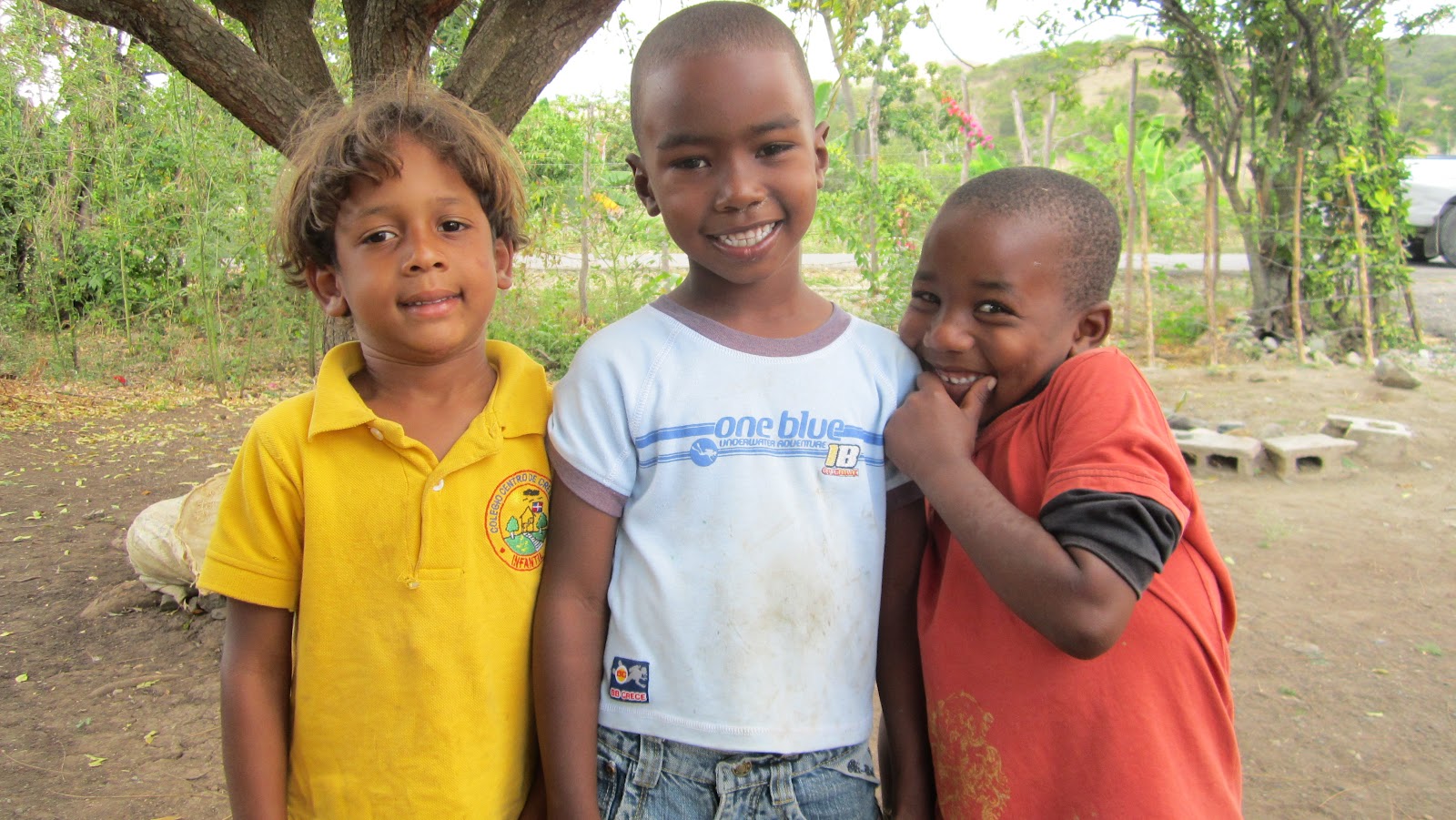
I just got back from the southwest region of DR, specifically Azua and San Juan, doing “survey” for this summer’s AMIGOS program in the island (http://amigoslink.org/project/dominican-republic-san-juan). Along with the Plan International (AMIGOS’s partner agency here) officials, I visited approximately 8 communities in San Juan and about 10 in Azua. In some of them, we stopped, met active youth and involved community members, and talked about previous and future AMIGOS experiences.
All of the communities were quite poor. I took pictures of the different places we visited for my report, but to be honest, they all looked the same after a while: narrow unpaved roads edged by intercalated [once] brightly colored wooden houses and brown (less pretty) houses of similar architecture. They all had either zinc or thatched roofs, with a little space in the front for sitting under the shade of a tree during the hottest hours of the day. There was also the occasional (and random) castle-like construction, which usually belonged to someone from the community who had managed to move to Spain, New York, or Puerto Rico.
As I mentioned, I had to take pictures throughout this trip for my survey report. At first, I was a little shy. It didn’t feel OK to take pictures of places and people without permission, so I tried to do it when no one was looking (perhaps not the most ethical approach). The more I saw, the more I got into it- it just felt as if the whole place was a set: everyone looking so natural, going about their business in this perfectly still and picturesque rural area: carrying plantains, working in the field… looking poor, and so perfect for a post card, an NGO brochure, a Ministry of Culture newsletter, a political campaign poster, and so on.
One of the places I visited was the house of a young man who had volunteered nationally last summer, and was looking to volunteer abroad this time around. We chatted under a tree outside his house, and were accompanied by his neighbors: three cute little boys, with dusty faces, dirty clothes, and no shoes. There was that feeling again: I must capture this image! I asked politely if I could take a picture of them, and they excitedly said yes. As I got ready to take the picture, their mother yelled from inside the house: “Wait, they are dirty and have no shoes on!” Then the cab driver said, “let her take it, it’s the reality we live in.”
The mother was completely right. How many of us are usually looking sexy when hanging around the house on totally normal days? Even on not such regular days, are we always ready and willing to take a picture that could potentially be posted on Facebook, much less a brochure of some kind? NO. We take time, we get ready, and we try to look our best. Then, why must these “at risk” people look dirty and raggedy in ALL our photos?
Travelers, let’s take a step back, think about their perspective, and give our subjects a minute to look their best. I understand that it is sometimes necessary, but not every picture has to be a “Feed my Starving Children” pose. Regardless of background and socioeconomic standing, we all want, and should, look our best for the world.
Btw. I took the picture anyway.
Thursday, February 2, 2012
A life of meaning
Today, as I entered my apartment building to have lunch, I saw a man that, despite having never seen him in my life before, I immediately grew to admire. I don’t know his name, his age, or his history; all I know is that he sells avocados. Sure, there are many men who sell avocados and other fruits (yes, avocado is a fruit) in the street, but not many are like this one. This guy, under the blindingly bright sun of noon (and probably starting from the early morning) walked up and down the streets of Santo Domingo, pushing a piece of wood with a wheel, screaming out of the top of his lungs, “AGUACATEEE!” again and again.
He was wearing a big blue, and dirty button down shirt rolled up in the sleeves, worn-out jeans, and crocks so wasted by the hot pavement that his soles touched the ground. He was a very dark man, with no hair, and missing more teeth than one is used to. He was a hard-working man, with a voice so strong that it bounced from tower to tower in the street with an echo, trying to reach the ears of the wealthy people eating lunch, and hopefully craving aguacate, in their expensive apartments.
I watched him from the moment I got off my car to the moment I entered the building… and my eyes teared.
The other day a friend posted on Facebook: “Life is not about finding meaning, it’s about making meaning.” I wish I could change this man’s situation in a more meaningful way than buying him an avocado or two. But as much as I want to, I alone will never be able to change everyone’s lives. Life gave him lemons, and this man made lemonade and made his life, despite difficult, meaningful. Many of us have much sweeter fruits, yet can’t think of anything to do with them. I suggest we watch, learn, and start making smoothies to share with those who only got lemons. Giving, sharing, supporting can give meaning to our lives, and that of others.
Sunday, December 25, 2011
Blindness at the Stoplight
It’s 1pm, I’m driving home for lunch and the streets are filled with hungry drivers and permanently angry taxi men. Excessive beeping and honking fill the air, along with dark smoke emitted by the old public bus in front of me. As the traffic slowly advances, a woman tries to forcefully cut in front of me- I yell at her and join the madness.
Rush hours in Santo Domingo are not particularly pleasant, but are no doubt entertaining. Among others, waiting in traffic you will find men, women, and children selling: frozen bottled water, ice cream, popsicles, menthol and TV antennas, candy, baby parrots, stuffed animals, fruits in season, sunglasses, school supplies, cell phone accessories, vegetables, and nuts. There are also beggars and window cleaners, both of which have their own spectrum. Encountering these people in traffic has the power to trigger numerous emotions… or none at all.
During my first few weeks living here (and in all my previous shorter visits) I used to feel sorry for these ambulatory figures. How much money could that guy possibly make selling baseball stickers? Where are that kid’s parents? Is that window cleaner my age? Why are they there and I here? Without thinking twice, I gave my money to beggars and bought things that I didn’t need. But things change.
Experiencing this traffic everyday, seeing the same beggars, the same random sellers, and the same unnecessary and annoying window cleaners has somehow made me blind. I have become immune to these people and their needs… not necessarily a great thing for someone looking to seek a career in public health and/or social work.
Luckily, I caught myself doing it: looking away when the same guy (with no apparent disability) knocked on my window asking for change, screaming “NOOOO” when the window cleaner threw his dirty sponge at my windshield (from a block away) right after I come out of the carwash, choosing not to buy an avocado even though I knew I could eat it at lunch…
The truth is that I got sick of the “bullshit.” For a while (after my sorry period) I thought that many of these people could be looking for jobs instead of begging, going to school (at least part time) instead of hanging out in the streets and cleaning some windows here and there, that parents could be sending their children to school instead of to ask for money.
But I have reconsidered: Who the hell am I to judge them? I know nothing about the situation in which these people find themselves, let alone about the way they could/should spend their time. The only thing I know for sure is that I would hate to be in their place, and if they knew a way to get out of it, they probably would.
So in this season of giving, I would like to bring attention to the blindness to sameness that inadvertently takes us over. Lets pay careful attention to our routines and spot people that may be in need. I’m not suggesting we give money to every beggar in the street, but rather anything we can provide to anyone that crosses our paths (some beggars appreciate smiles too!). Whether it’s a dollar, a smile, a hug, or a simple look, it can make someone feel special, loved, cared for. The least we can do is notice; the rest comes naturally. Lets open our eyes.
Wednesday, January 12, 2011
Compliments
Have you ever gone to meet a friends newborn, the baby everyone has been waiting for, and the moment you meet him/her the first thing that comes to your mind is how ugly the baby is? Well, there are some really ugly babies out there. Some change for good, some don’t. But regardless, you HAVE to give your friend compliments of her new baby because she loves it and it is not returnable. In those moments, you say things like, “wow, he is so big and strong!” or “look at how wide his eyes open, Im sure he will be really smart!” or “que graciosito!,” which means friendly or nice. (Take notes, if you ever have a baby, and your friends avoid the word “cute” at all costs, you know there is a problem.)
The point is that people like compliments, whether it is about their babies or their shoes. For instance, how much does it suck when the first thing people tell you is that you look really tired? Whether you are tired or not, the fact that someone told you that you could look better already kills your mood a little. Luckily, receiving positive comments has the same psychological effect, but in a good way. One day my mother and I were in the train, an old homeless-looking man walks in and sits across from us. My mother, being the polite person that she is, gives him a half smile and continues to talk to me. Before the man got off the train, he approached her and told her she had the most beautiful smile he had ever seen. My mother was in the clouds, and smiled as hard as she could for the rest of the day to see if she would catch another compliment. “I bet if I had given him a full smile I would have blown his mind away!” she said.
Compliments are nice and everyone likes getting them. The best part is that the more you give, the more you receive! There is almost always something good to say about someone. Say it to them! Wouldn’t you want to hear it too?
Saturday, January 8, 2011
The Power of a Juicebox
Two girls were walking down the street, one was pretty, one was sleek. Kidding! Lol. That’s not how the story goes. Ok, here we go again:
Two girls were walking down the street on a warm, sunny Sunday afternoon. They were eating doughnuts and drinking juice. It was noisy and busy out, as people in Santo Domingo tend to take Sunday afternoons to go out with the family. On their trip, the girls passed by two big malls, a bike shop, and several other commercial places, including an amusement park with a wax “ice” skating rink in the parking lot. The traffic was heavy, but fluid, and the sidewalks were full of children and their parents trying to get into the new “ice” skating sensation. It was crowded, there was loud music playing and cars blowing their horns, but the walk was pleasant nonetheless. It had been a while since the two friends had been together, especially in an environment so full of life.
As they walked further down the same road, the street got significantly less lively. They passed by a few banks and other closed businesses; there was neither music nor people, just cars and boys that cleaned the front glass of people’s cars for change. They passed a Haitian family walking towards the busy part of the road that seemed surprisingly happy (sadly, this is not a common scene in Sto. Dgo.), and a man painting the wall of a bank. The man was the first person either of the girls had seen working that day: he was sweating, breathing hard, and sitting on the floor next to the wall he was almost done painting. The girls made no comment about him, but soon after passing him, Juana turned around, took a small juice box out of a plastic bag, and offered it to the tired man saying: “Drink this, friend. You need a break.” The man, with white paint on his hands and his face, took the juice with a pleasantly confused expression, and watched Juana walk away with her friend, Maria. Again, no comment was made about the situation even though the Maria seemed surprised.
The following week Juana slept over Maria’s house. On their way out to get a cab in the morning, Maria picked up the newspaper from outside the door and took it along (she was very serious about reading her own newspaper every morning). But that morning, instead of reading it as she normally did, she gave it to the cabdriver after arriving to their final destination. She later told Juana she had never done that before, but that seeing her share her untouched juice with the painter made her feel “fuzzy” and inspired her to do the same. Juana had no idea her interaction with the painter would impact anyone’s behavior, but it did, and maybe that of the painter too.
Names changed to protect the identity of those involved.
Sunday, January 2, 2011
Smiling is Caring (because it rhymes!)
A few days ago, I was sitting in the front seat of my brother’s car. It was rush hour on a really hot, sunny day in Santo Domingo; one of those where no one wants to go outside because of the heat makes people sweaty, sticky, and irritated. My brother and I had to go to my aunt’s house to pick up my other brother, Piky. We were on a red light that had turned green four times but we hadn’t moved one inch in 20 minutes because a useless traffic agent (AMET) was directing the transit instead of the perfectly functional street light. The radio was on playing reguetón, my brother was leaning against his window and I against mine. We were both really miserable and barely spoke to each other – only once, to complain about picking up Piky…
While staring blankly out my hot window waiting for the AMET to let us move forward I spotted a little girl sitting under the sun, on the sidewalk watching the cars on the road. Her hair was messy, she was covered with dust from the road and not wearing much clothes. It was obvious that she was one of the local beggars of that road, but at that moment, it seemed as if she was taking a break from work; the sun was draining. When I saw her, she saw me too… I stared straight at her, not realizing what I was doing because I was still daydreaming, but her smile brought me back to reality. Yes, she smiled at me, for no reason! I had no choice but to smile back at her because…. I honestly don’t know. It was genuine and contagious, and it brought both joy and guilt to my heart. Why wasn’t I the one smiling at her? I was sitting comfortably under the roof of a car on my way to somewhere; she was under the sun, in the street, with no plans to leave the dirty road. Why was she smiling? She was smiling because, as small as they may be, there are always things to be happy about. The little girl taught me a lesson and brought joy to my heart with just a smile. So I smile and hope that, like that little girl, my smile can plant happiness, satisfaction, or optimism in the heart of others.
---------
A little smile cheers up the heart, maintains a good mood, conserves peace in the soul, contributes to good health, beautifies the face, triggers good feelings, inspires behavior. Why not try it?
Count… the number of smiles that return yours in a single day. That number represents the time that you have planted a spark of happiness, satisfaction, optimism, or confidence in the heart of others.
Your smile… can bring new life, hope, and courage to those who are tired, desperate, worried, or to those who just are.
-Translation from “El Secreto de la Sabiduría Humana”
Subscribe to:
Posts (Atom)